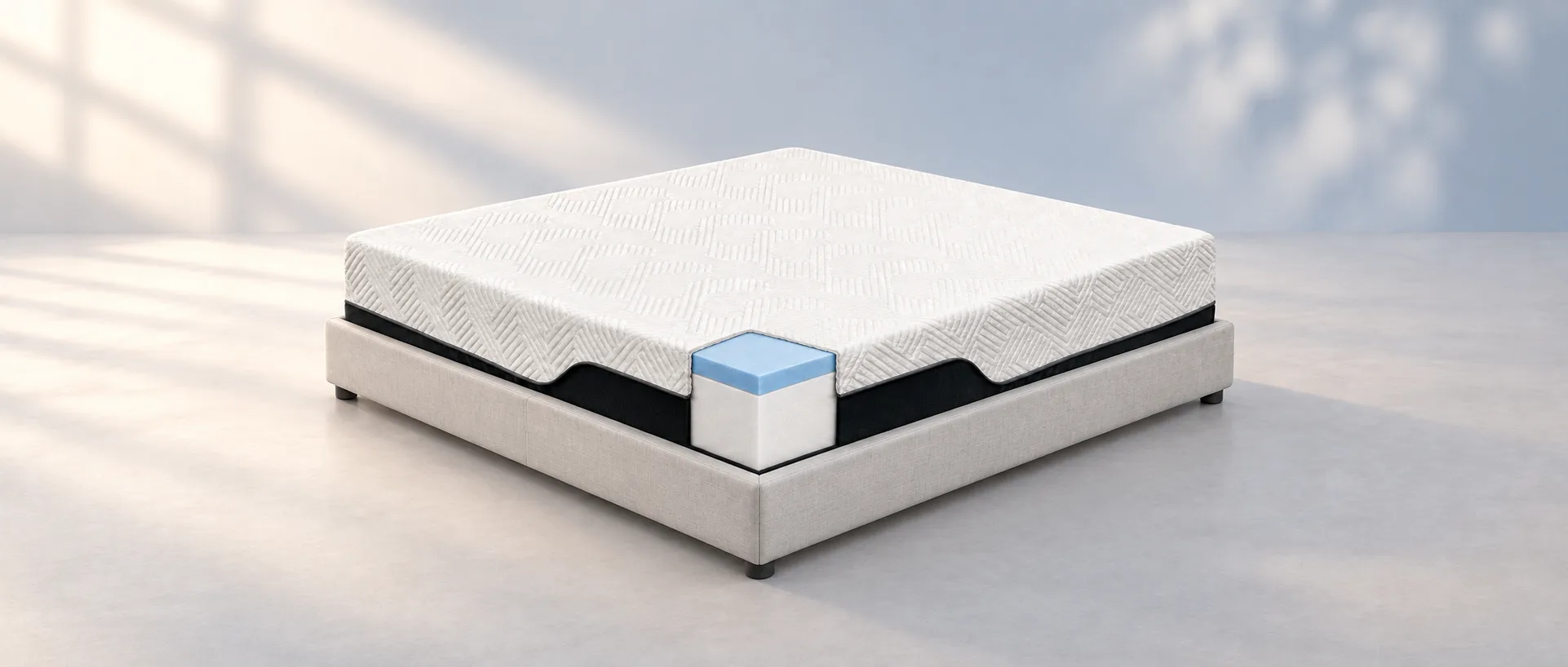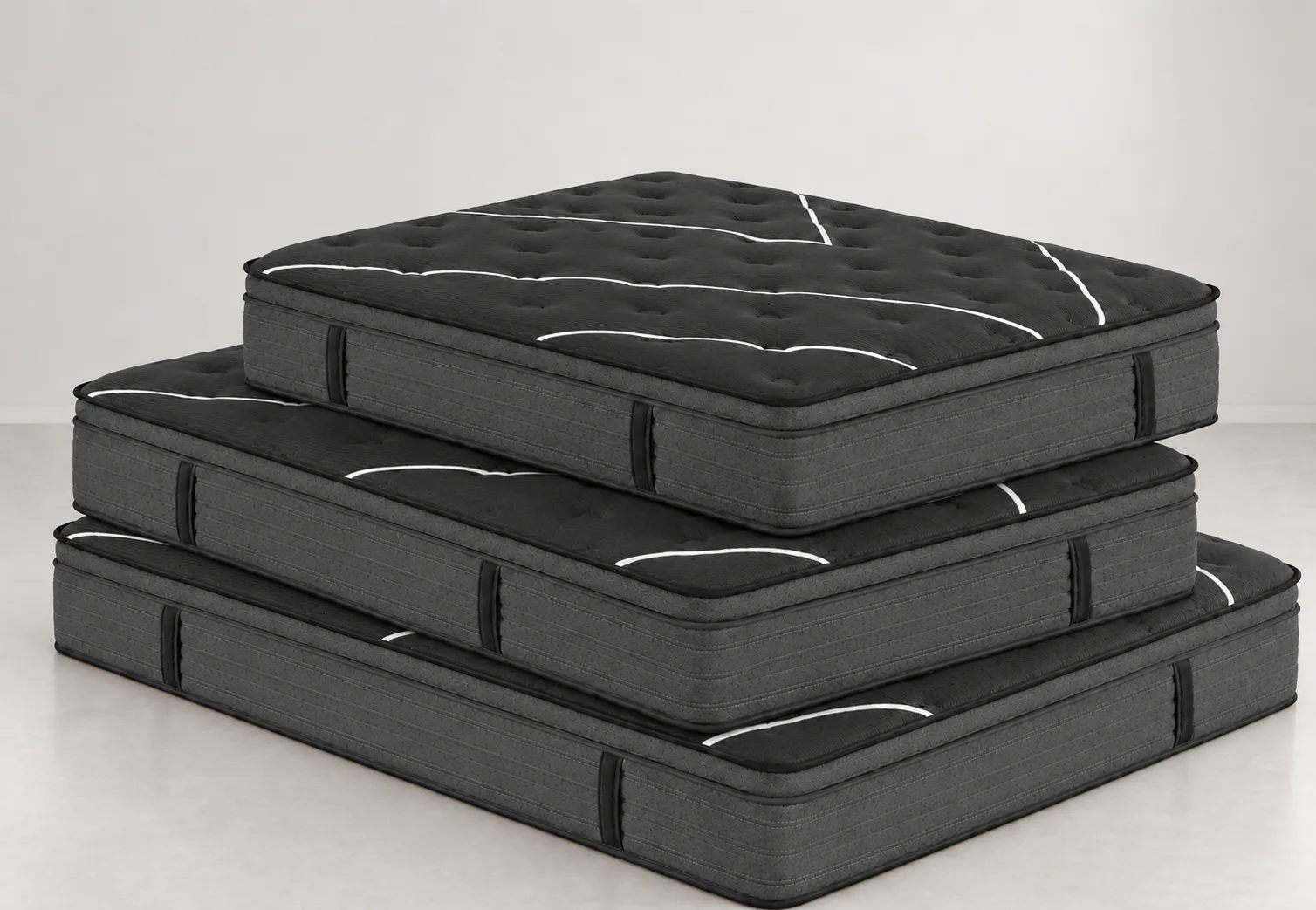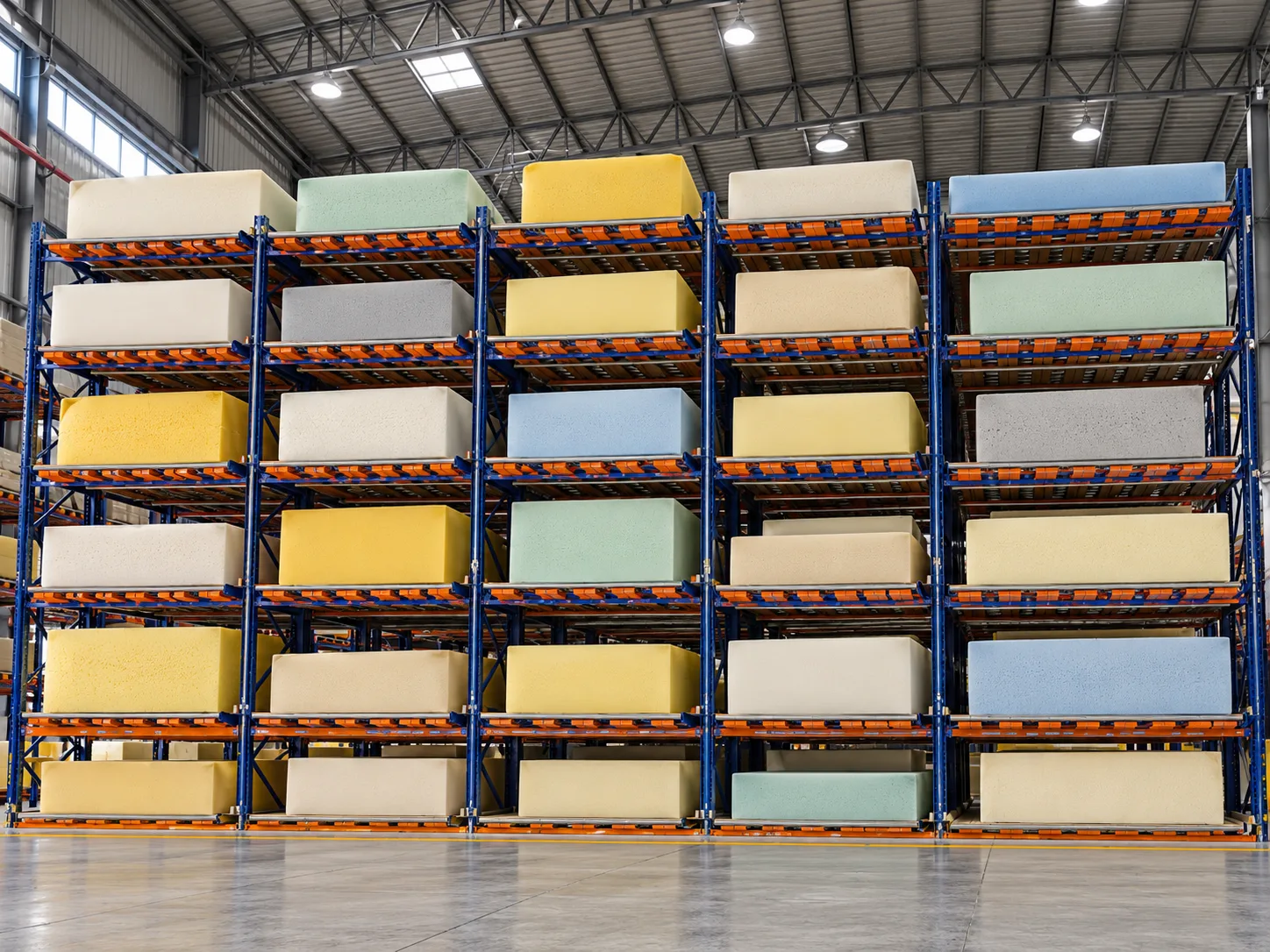
Foam density is one of the most important specifications for mattress brands, importers, wholesalers and hospitality project buyers. It influences mattress durability, weight, production cost and overall product positioning.
However, a higher foam density does not automatically mean a firmer or more comfortable mattress. Different foam types, formulations and layer structures can produce very different performance characteristics even when their density values are similar.
This guide explains how mattress foam density is measured, how it affects product performance and how B2B buyers can select suitable specifications for different markets and mattress collections.
1.What Is Mattress Foam Density?
Foam density refers to the amount of material contained within a specific volume of foam. It is normally expressed in kilograms per cubic meter (kg/m³) .
A higher-density foam contains more raw material per unit of volume. It is generally heavier and may offer better durability and resistance to long-term compression. Lower-density foam contains less material and is usually lighter and more economical.
2.Foam Density vs. Foam Firmness
Foam density and firmness are different specifications.
Density measures how much material is present in the foam.
Firmness measures how much force is required to compress the foam.
Firmness is commonly expressed as ILD, IFD or compression hardness, depending on the market and testing method.
A high-density foam can be manufactured with a soft feel, while a lower-density foam can be formulated to feel relatively firm. Density is more closely associated with foam weight, structural stability and potential service life, whereas firmness directly affects the initial comfort and support sensation.
For accurate product development, B2B buyers should specify both density and firmness instead of using density alone to describe the required feel.
3.Common Mattress Foam Density Ranges
Density ranges cannot be applied equally to every foam material. Memory foam, conventional polyurethane foam and high-resilience foam have different formulations and performance expectations.
The following ranges provide a general purchasing reference. Actual classifications may vary according to the supplier, formulation, testing standard and target market.
| Foam type | Typical density range | Common applications |
| Conventional polyurethane foam | 20–35 kg/m³ | Quilting, comfort layers and entry-level support layers |
| High-density polyurethane foam | 30–45 kg/m³ | Mattress cores, transition layers and reinforced edges |
| High-resilience foam | 35–55 kg/m³ | Premium support cores and responsive comfort layers |
| Memory foam | 40–80 kg/m³ | Pressure-relief and contouring comfort layers |
| Latex foam | Approximately 60–95 kg/m³ | Responsive comfort layers and full-latex mattress cores |
These values should be treated as general ranges rather than universal quality grades. A mattress manufacturer should provide the specific density, firmness and test data for the foam used in each layer.
4.Conventional Polyurethane Foam Density
Conventional polyurethane foam is widely used in mattresses because it is versatile, cost-effective and available in different firmness levels.
Lower-density polyurethane foam is often used in quilting panels or entry-level mattresses where controlling cost and finished-product weight is important. Medium- and higher-density polyurethane foams are more suitable for structural comfort layers, transition layers and mattress cores.
For B2B buyers, the appropriate density depends on the thickness and function of the layer. A thin quilting layer does not need the same density as a foam core expected to provide long-term support.
5.Memory Foam Density
Memory foam is designed to respond to body heat and pressure, allowing it to contour around the sleeper. Its density affects product weight, contouring characteristics and resistance to long-term wear.
Common mattress memory foam densities include:
40–50 kg/m³: Frequently used in competitively priced mattresses and thinner comfort layers.
50–60 kg/m³: Suitable for many mid-range products requiring a balance of pressure relief, durability and cost.
60–80 kg/m³: Often selected for premium collections where buyers prioritize a denser feel and stronger long-term performance.
Density alone does not determine the complete memory foam experience. Response speed, airflow, temperature sensitivity, firmness and cell structure also affect how the material performs.
Gel particles, perforations or open-cell formulations may be added to support a particular cooling or marketing concept, but these features should be evaluated together with the complete mattress construction.
6.High-Resilience Foam Density
High-resilience foam, also known as HR foam, is formulated to provide greater elasticity and faster recovery than conventional polyurethane foam.
It can be used as a responsive comfort layer, transition layer or supportive mattress core. Depending on the formulation, HR foam may provide better resilience and load-bearing performance without creating the slow-response sensation associated with memory foam.
For premium foam mattresses, buyers may consider HR foam in the 35–55 kg/m³ range. However, resilience, compression set and support factor should also be checked before comparing products.
A foam should not be classified as high-resilience material based only on its density.
7. How Foam Density Affects Mattress Performance
7.1 Durability
Higher-density foam generally contains more polymer material and may resist softening, body impressions and compression better than comparable lower-density foam.
However, durability also depends on:
*Foam formulation
*Raw-material quality
*Cell structure
*Compression set
*Layer thickness
*User weight
*Climate and humidity
*Packaging and recovery conditions
*Mattress construction
Buyers should therefore avoid using density as the only indicator of mattress lifespan.
7.2 Support and Pressure Distribution
Density can influence the structural stability of a mattress layer, but pressure relief is also affected by firmness, thickness and foam type.
A thick, soft memory foam layer may provide deeper contouring, while a firmer HR foam layer may offer a more responsive surface. Combining different materials allows manufacturers to balance comfort and support for a specific customer group.
7.3 Mattress Weight
Higher-density foam increases the finished weight of the mattress. This may affect handling, packaging, warehousing and transportation costs.
The difference becomes particularly important for compressed mattresses sold through e-commerce or shipped in large container quantities. Buyers should evaluate whether the performance advantage of a denser foam justifies the additional product and freight cost.
7.4 Production Cost
Higher-density foam normally requires more raw material, which can increase the mattress cost. Specialized formulations, certifications and performance additives may also affect the quotation.
For commercial purchasing, the objective is not always to select the highest available density. The better approach is to match the foam specification to the intended retail price, warranty, sales channel and target customer.
7.5 Product Positioning
Foam density can support different mattress positioning strategies:
| Product positioning | Typical specification approach |
| Entry-level collection | Cost-controlled foam densities and simplified layer structures |
| Mid-range collection | Balanced density, comfort performance and durability |
| Premium collection | Higher-performance foams, thicker comfort systems and stronger material specifications |
| Hotel project mattress | Stable support, commercial durability and project-specific cost control |
| E-commerce mattress | Balanced weight, compression recovery, shipping efficiency and consumer comfort |
The complete construction should remain consistent with the product claim. A mattress should not be marketed as premium solely because one thin layer uses high-density foam.
8. Recommended Density by Mattress Layer
Every foam layer performs a different function. Buyers should evaluate density according to where the foam will be used.
8.1 Quilting Layer
Quilting foam adds surface softness and improves the appearance of the mattress panel. Because it is normally thin, its density may be lower than that of the main comfort and support layers.
The buyer should also review softness, breathability and resistance to compression, especially for mattresses with thick quilted tops.
8.2 Comfort Layer
The comfort layer affects pressure relief, contouring and the initial feel of the mattress. Memory foam, soft polyurethane foam, latex or responsive HR foam may be used depending on the desired positioning.
Density should be considered together with layer thickness. A two-centimeter layer and an eight-centimeter layer with the same density can perform very differently.
8.3 Transition Layer
A transition layer reduces the abrupt difference between a soft comfort layer and a firm support core. It can also help improve weight distribution and prevent the sleeper from sinking too deeply.
Medium- or high-density polyurethane foam and HR foam are commonly used for this purpose.
8.4 Support Core
The support core provides the main structural foundation of an all-foam mattress. It generally requires greater stability than a thin surface layer.
Buyers should pay close attention to density, firmness, compression set and core thickness. For heavier users or commercial applications, the manufacturer may recommend a stronger core or a multi-zone structure.
8.5 Edge Support
Higher-density or firmer foam may be used around the perimeter of a mattress to improve sitting stability and usable sleeping space.
For spring mattresses, foam encasement can be designed according to the required edge firmness and packaging method.
9. How to Choose the Right Foam Density for Your Market
Before confirming the mattress construction, B2B buyers should consider five questions:
What is the target retail price?
Is the product positioned as entry-level, mid-range or premium?
What warranty or expected service life will be offered?
Will the mattress be sold in stores, supplied to hotels or shipped as a bed-in-a-box?
What comfort preferences and body-weight ranges are common in the target market?
The answers help the manufacturer recommend an appropriate combination of foam type, density, firmness and thickness.
For example, an entry-level e-commerce mattress may use a cost-efficient support core with a thinner memory foam layer. A premium model may combine denser memory foam, responsive HR foam and a stronger base. A hotel mattress may use firm, durable foam around a spring system to support frequent commercial use.
10. Work with an Experienced Mattress Manufacturer
Choosing foam density is ultimately a product-development decision rather than a single-material comparison.
MIJUE works with mattress brands, wholesalers, retailers, hospitality buyers and cross-border e-commerce sellers to develop customized mattress constructions. Foam type, density, firmness, thickness, cover design, packaging and product positioning can be adjusted according to the buyer’s target market and budget.
By testing complete mattress samples before mass production, buyers can evaluate the actual comfort, support and recovery performance instead of relying only on individual material specifications.
Contact MIJUE to discuss your target price, market positioning and required mattress performance. Our team can recommend a suitable foam combination for your OEM or ODM mattress project.
FAQ
Q:What is a suitable foam density for a mattress?
A:There is no single density suitable for every mattress. The right specification depends on the foam type, layer function, target price, expected durability and product positioning. Memory foam, conventional polyurethane foam and HR foam should be evaluated according to their respective density ranges.
Q:How does foam density affect mattress cost and durability?
A:Higher-density foam generally uses more raw material and may provide better resistance to softening and long-term compression, but it also increases product weight and cost. Actual durability also depends on the foam formulation, layer thickness, compression set and overall mattress construction.
Q:Can MIJUE customize foam density for OEM and ODM mattresses?
A:Yes. MIJUE can customize foam type, density, firmness and layer thickness according to the buyer’s target market, budget and product positioning. Samples can be developed and tested before mass production to confirm the mattress comfort, support and compression-recovery performance.
Q:Why Choose MIJUE?
A:
1.Materials Advantage: We offer a wide selection of high-quality materials — including memory foam, latex, and cooling gel — to meet diverse market needs. With large-scale and stable production capacity, we ensure consistent quality and reliable supply for every mattress order.
2.Lowest MOQ: Our minimum order quantity (MOQ) starts from just 100 mattresses, giving our partners the flexibility to test markets, customize designs, and expand with confidence.
3.Trusted B2B Mattress Manufacturer : As a trusted B2B mattress manufacturer, MIJUE provides a full range of solutions — from hybrid, hotel and home mattresses to pocket spring and custom designs.
Explore our exclusive collection created for global partners, and let your imagination take flight.
At MIJUE, we offer expert guidance and collaborative support to bring your unique concepts to life, ensuring every mattress stands out in your market.
Q: What certifications do your products have?
A: Our products are certified by SGS, CE, and OEKO-Tex, meeting international standards for safety, environmental protection, and quality.