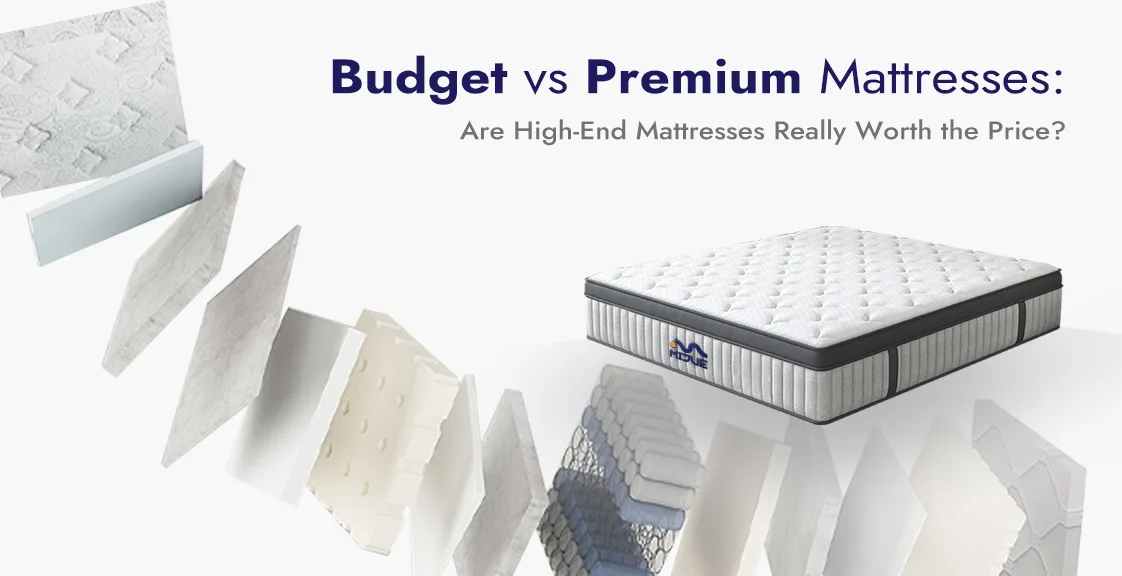
Mattress prices vary widely, but the real question is simple: what do you actually get when you pay more?
This article compares budget vs premium mattresses by focusing on the differences that truly affect sleep quality, durability, and long-term support—helping you decide whether a high-end mattress is worth the price.
1. What Is the Real Difference Between Budget and Premium Mattresses?
1.1 Budget Mattresses: What You’re Paying For
Budget mattresses are designed to meet basic sleep needs at a lower cost. They typically use simpler materials and construction, which makes them suitable for short-term or occasional use.
Key characteristics include lower-density materials, limited structural reinforcement, and faster performance decline over time.
1.2 Premium Mattresses: What the Higher Price Covers
Premium mattresses are built for long-term performance and stability. The higher price reflects better materials, more refined support systems, and consistent comfort over many years.
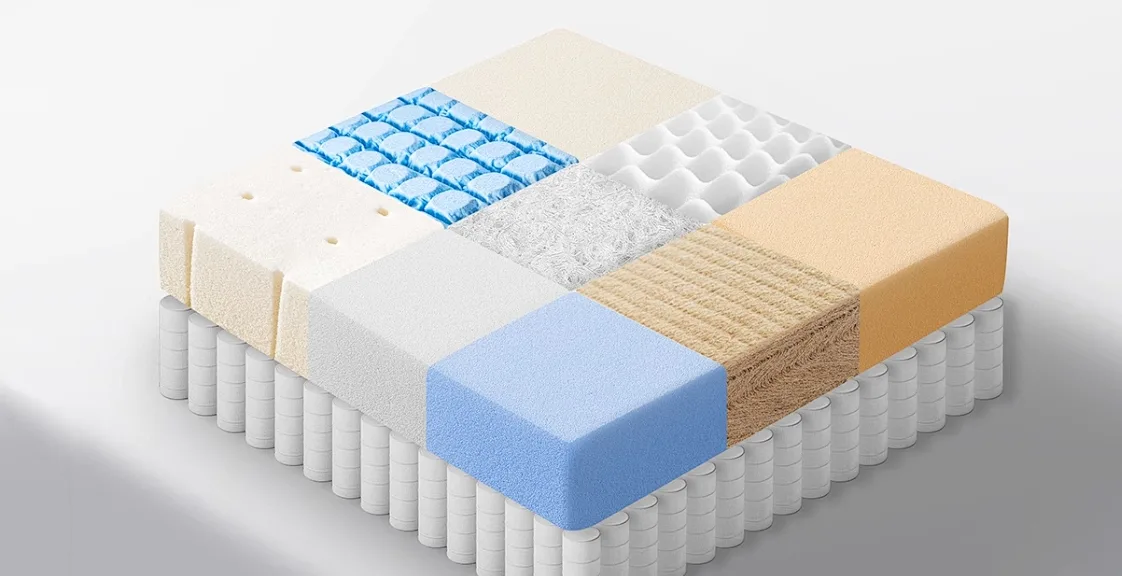
2. Materials and Support: Where the Real Gap Appears
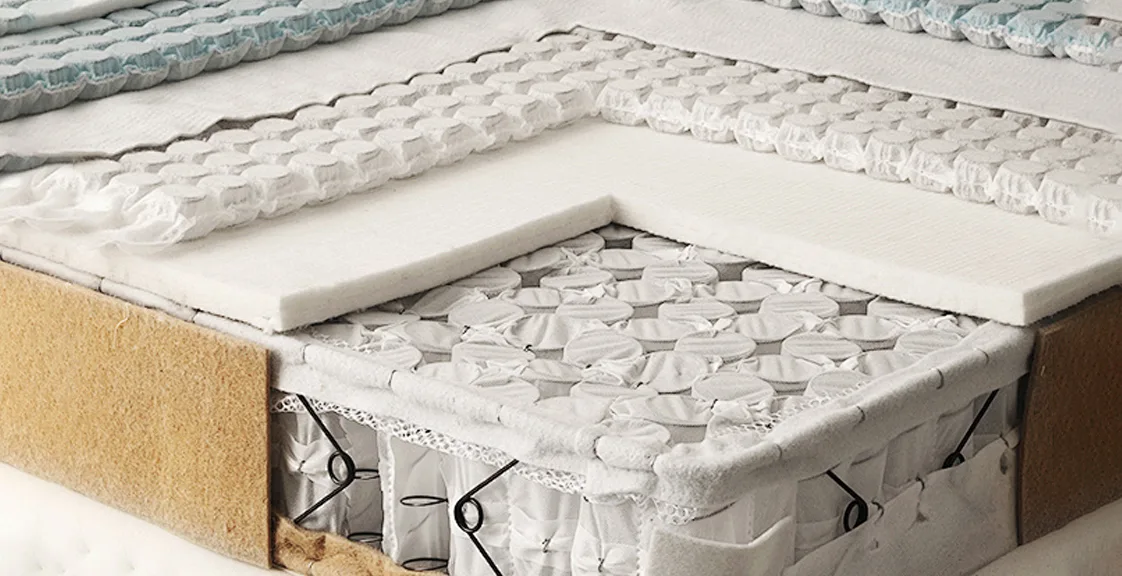
The most meaningful differences between budget and premium mattresses are often hidden beneath the surface. These factors may not be obvious in a showroom but strongly affect how a mattress performs after years of use.
Key Hidden Differences
| Hidden Factor | Budget Mattresses | Premium Mattresses |
| Foam Density | Lower density, softens quickly | Higher density, retains support |
| Material Aging | Performance drops sharply | Gradual, predictable aging |
| True Zoned Support | Often absent or cosmetic | Functional zoning based on body weight |
| Edge Stability | Edges compress over time | Reinforced edges keep shape |
| Heat Management | Heat buildup common | Designed airflow or cooling layers |
| Long-Term Spine Support | Support weakens as materials wear | Consistent spinal alignment over years |
3. Comfort and Sleep Quality
3.1 Pressure Relief
Premium mattresses distribute weight more evenly, reducing pressure on shoulders, hips, and lower back.
Budget mattresses may feel comfortable at first but often lose support over time.
3.2 Motion Isolation
For couples, motion isolation matters:
Budget mattresses transfer more movement
Premium mattresses significantly reduce sleep disturbance
4. Durability and Long-Term Value
Lifespan Comparison
Budget mattresses: 3–5 years
Premium mattresses: 8–12 years or more
Replacing cheaper mattresses more frequently often reduces their apparent cost advantage.
5. Are High-End Mattresses Really Worth the Price?
If you only consider upfront cost, budget mattresses win.
If you consider sleep quality, durability, and fewer replacements, premium mattresses usually provide better long-term value.
6. Who Should Choose Which?
6.1 Budget Mattress Is Enough If:
The mattress is for temporary use
It’s for a guest room or rental
Budget is the primary concern
6.2 Premium Mattress Is Worth It If:
You want consistent comfort over many years
You experience back or pressure-point discomfort
You share a bed and need motion isolation
7. Frequently Asked Questions About Budget vs Premium Mattresses
7.1 Why do some premium mattresses feel similar to budget ones at first?
Many premium mattresses are designed to feel comfortable immediately, just like budget mattresses.
The real difference appears after months or years of use, when higher-density materials retain support while lower-quality foams soften and lose structure.
7.2 Is a higher price always related to better materials?
Not always. Price alone does not guarantee quality.
What matters is material density, support design, and quality control, not branding or marketing claims. Some mid-range mattresses may outperform poorly designed “luxury” models.
7.3 Why do premium mattresses age more predictably?
Premium mattresses are engineered with controlled material aging curves, meaning they lose firmness gradually and evenly.
Budget mattresses often degrade unevenly, leading to localized sagging that affects spinal alignment.
7.4 Can a budget mattress provide proper spine support?
In the short term, yes.
Over time, however, lower-density materials tend to soften, reducing consistent spinal support—especially for sleepers who use the mattress nightly.
7.5 Why is edge stability more important than most people think?
Edge stability affects:
Usable sleep surface
Ease of getting in and out of bed
Long-term structural integrity
Premium mattresses reinforce edges to prevent collapse, while budget mattresses often neglect this area.
7.6 Is heat retention mainly a comfort issue or a material issue?
It is primarily a material and structure issue, not just comfort.
Closed-cell foams trap heat as they age, while higher-quality foams and ventilation designs maintain airflow over time.
7.7 Do premium mattresses actually cost less over time?
Often, yes.
Replacing a budget mattress twice in ten years can cost as much—or more—than purchasing one premium mattress that lasts the entire period.
7.8 Who benefits the most from investing in a premium mattress?
Premium mattresses provide the most value for:
People who sleep on the mattress daily
Sleepers with back, shoulder, or hip sensitivity
Users who want consistent support over many years
For temporary or occasional use, a budget mattress is usually sufficient.